Terroir
Douro Harvest: How to Pick a Vineyard of 41 Grape Varieties

There is one question that keeps coming up on the terraces of the Torto valley, and no one can answer it from a distance: should this plot be picked today or a week from now? At Quinta Vale D. Maria, the Douro harvest involves 41 grape varieties planted side by side more than sixty years ago, each ripening in its own time.
Anyone who visits the estate at this time of year will find the viticulture team out in the vineyard, a bunch of grapes in hand, tasting berry by berry. This is how the decision is made, and it is why it is the most demanding one of the year: twelve months of work in the vineyard come down to choices made plot by plot, by hand.
Forty-one varieties, many calendars
Quinta Vale D. Maria’s old vines cover around 15 hectares in the Torto valley, in the Cima Corgo, and are more than 60 years old. They were planted the way vineyards were planted in the Douro before the modern idea of single varietals existed: everything together, mixed within the same plot, with no record of what went into each row. Today this is called a field blend, and here it means 41 identified varieties. They include grapes authorised in the Douro Demarcated Region, such as Rufete, Tinta Amarela, Tinta Francisca, Sousão, Touriga Nacional, Touriga Franca and Tinta Roriz, along with a group of old varieties that have all but disappeared from the region.
This is where the challenge begins. Each of these varieties has its own rhythm. Touriga Nacional may be ready while Tinta Amarela is not; Sousão holds on to its acidity when others have already lost theirs; Rufete ripens late and does not like to wait. In a modern vineyard, each variety has its own plot and is picked when that plot is ready. In an old field-blend vineyard, they all share the same row of vines.
Plot by plot, bunch by bunch
The first step is to break the decision down. Instead of a single harvest date, there are several. Each plot is monitored separately and picked at a different moment, as its balance of ripeness, acidity and fruit health reaches the point the team is looking for. In a vineyard like this, two neighbouring plots can be more than a week apart.
The second step is timing. For the white varieties, picking starts in the early hours of the morning, while the grapes are still cool, to prevent oxidation and preserve aroma before the temperature rises. It is a short window that calls for a concentrated team and the shortest possible time between cutting the bunch and its arrival at the winery.
The third step is sorting at the winery door. Whatever slips through during the hand harvest is corrected here, bunch by bunch, before the grapes go on to be vinified. It is the last chance to remove what should be left out. In a vineyard where bunches vary in every plot, it is an essential stage.
The lagar
Foot-treading in granite lagares meets a specific need of this fruit, and it is worth understanding what that need is.
A mass of grapes from 41 varieties is uneven by definition: skins of different thicknesses, different levels of phenolic ripeness, berries of different sizes. Mechanical extraction applies the same force to the whole mass, and the result is just as uniform: the more delicate varieties give way too quickly, while the rest fall short. Foot-treading applies low, continuous, evenly distributed pressure. It works the must while leaving the stems and seeds intact, and draws out colour and structure gradually, with room to stop once extraction is sufficient. In a granite lagar, shallow and with a large contact surface, that margin of control is greater than in any vat.
The Douro harvest window
Each year offers a single opportunity. Pick a plot a week too early and the lost ripeness will not come back; a week too late and acidity and freshness are lost. And the decision is made at a time when the Douro weather can change within 48 hours.
That is why harvest is the most demanding time of the year. Everything done in the vineyard over twelve months depends on a set of decisions made in three or four weeks, and on a team trained to carry them out bunch by bunch, under time pressure.
Where to taste it
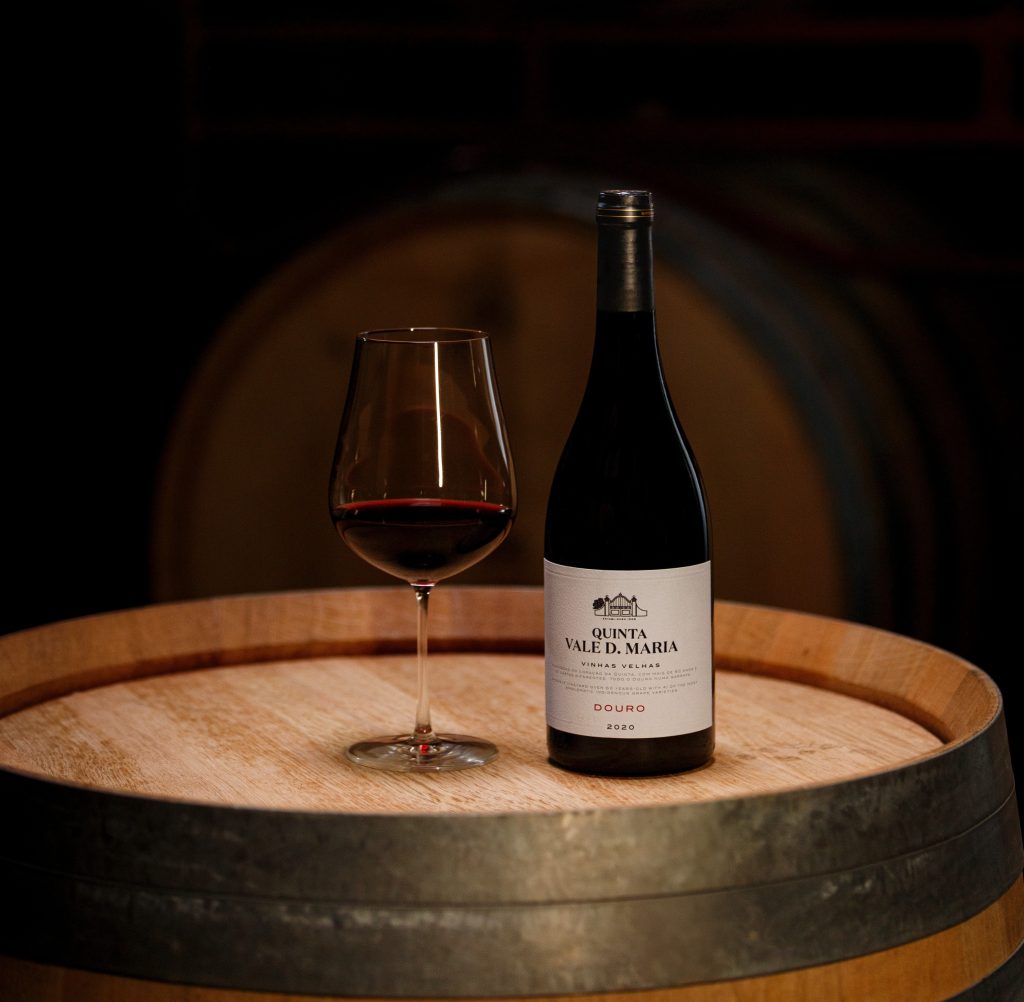
Quinta Vale D. Maria Vinhas Velhas reflects this work. It comes from those old plots and from the 41 varieties hand-picked at different moments, and it is aged for 20 months in new French oak barrels. What you find in the glass is ripe red fruit, floral notes of violet and rockrose, and a concentrated structure with a long finish. All of it is the result of a series of decisions made in the vineyard, one plot at a time.
See the harvest up close
The estate opened its doors to the public in August 2026, in Ervedosa do Douro, and harvest is the time of year when there is most to see. The wine tourism programme includes seven tastings and two masterclasses, among them the Prova Douro Clássico (Classic Douro Tasting) and the Prova Essência dos Terroirs (Essence of the Terroirs Tasting), which can be booked directly through the estate’s availability calendar.
Related Articles

Wine Tourism
Quinta Vale D. Maria: a unique wine tourism experience in the Douro
2 September, 2026

Events
The Douro in different expressions: a journey through the terroir
4 August, 2026

Old Vines
The Douro Vineyards in Summer: The Resilience of the Terroir
22 July, 2026
Wines
How to Use a Wine Decanter: A Guide from Quinta Vale D. Maria
19 June, 2026
Wine Pairings
Portuguese Gastronomy at Easter: Tradition, Terroir and the Art of the Table
2 April, 2026
